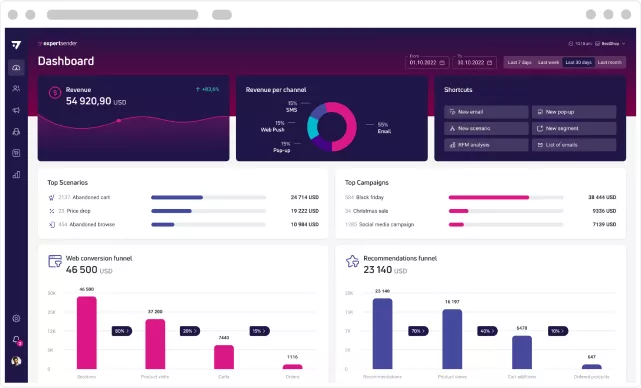
The e-commerce sales funnel – how do you build one?

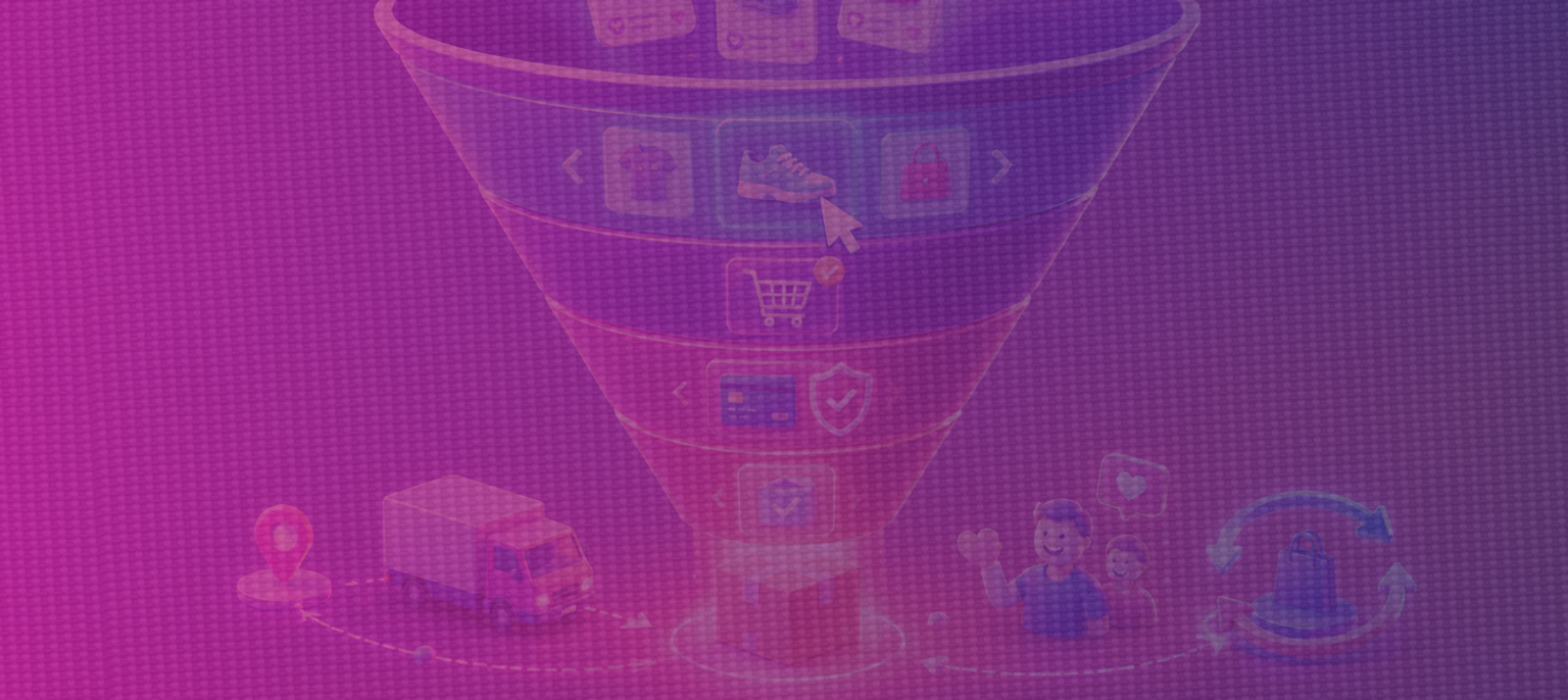
In an online shop, almost everything can be quantified. You know how many users visited the site and from which sources. You know how many people viewed a particular product page. You know how many customers abandoned their cart at the checkout.
The problem arises when traffic to your shop increases, and the figures mentioned above are scattered across several different tools and rarely form a coherent picture. A sales funnel, combined with a tool for organising customer data, helps you see where you’re actually losing orders and money.
This article is a simple implementation guide. Not one that will overwhelm you, but one that - after years of downplaying the issue - will finally allow you to build a sales funnel and start using it.
We’ll walk you through the specific steps that make the sales funnel actually work, rather than just remaining on a slide.
What characterises an e-commerce sales funnel?
An e-commerce sales funnel differs from the classic (brick-and-mortar or hybrid) model in that each stage has a precise counterpart in the data. You don’t have to estimate how many visitors have progressed to the next stage. You can check this in your analytics tool.
The second difference concerns the pace. Individual shoppers make purchasing decisions much faster than businesses, and with low-cost products, the entire purchasing process can sometimes be completed in just a few minutes. With more expensive equipment, the customer journey can stretch over weeks and involve several returns to the website. Knowing this, you can plan additional touchpoints, such as remarketing or additional campaigns featuring content that highlights so-called ‘social proof’.
The third point is specific to online shops alone. An abandoned shopping cart is a separate, measurable stage that simply doesn't exist in a traditional sales funnel. The customer has signalled their intention to buy but has backed out. You are aware of this and can respond.
There is one more condition without which the rest won't work. The e-commerce funnel only works if you can recognise that a returning visitor is the same customer as the one from a week ago. Without this, you see five anonymous visits instead of a single purchase journey.
That is why collecting data and combining it into a single Customer Profile is fundamental, not an afterthought. An email address from a newsletter subscription, a phone number, a history of products viewed, previous orders - only when combined with other data do they allow you to send the right message at the right time. This is the basis for automating communication at every stage of the funnel.
If you’re looking for an answer to the question of what a sales funnel is as a concept and where its name comes from, we’ve covered this in a separate article. Here, we’re focusing on implementation.
In an e-commerce store, five stages of the funnel are most commonly identified. The table below shows what happens at each stage from the customer’s perspective, in the data, and in your actions.
How to build a sales funnel for an e-commerce store
Building a sales funnel in e-commerce boils down to three steps. First, you assess the current situation; then, you address the stage with the highest drop-off; finally, you plan what happens after the purchase.
And then… you start the whole process afresh, adding further elements. The most important thing is to start working on the funnel and only develop the entire model over time. Starting too ambitiously could overwhelm you and cause you to shelve the project.
Step 1: Measure before you start making changes
Start by listing the figures for each stage of the funnel and counting the transitions between them. Only then will you see at which stage you’re losing the most people.
In practice, you’ll need a few metrics to start with:
- number of sessions,
- percentage of users who viewed a product page,
- cart abandonment rate,
- conversion rate for the entire shop.
Plus the average order value (AOV), so you know how much each recovered customer is actually worth.
Where can you get these figures? Google Analytics 4 covers most of them in its e-commerce reports - provided you’ve set up purchase events. If your reports only show sessions without any shopping cart data, that’s the first thing you need to fix. Without that, the rest of the analysis is pointless.
To analyse individual pages, you’ll need a second tool. Heatmaps show where users click, whilst session recordings show, for example, which form fields they pause at. When it comes to shopping cart abandonment, watching just a dozen or so recordings is enough to spot a recurring pattern.
Record your findings and observations in one place. The stage at which the highest percentage of people drop out is your bottleneck - and this is what requires your attention first and foremost.
Example:
A clothing shop records 20,000 sessions per month. 8,000 people open a product page, 1,200 add items to their cart, and 300 place an order.
The transitions look like this: 40% of sessions go to the product page, 15% from the product page to the shopping cart, and 25% from the shopping cart to the order. This is what the conversion funnel looks like in figures, and the conversion rate for the entire shop is 1.5%.
The biggest drop-off occurs between the product page and the shopping cart - 85% of people who have already viewed a specific item drop out. These are the people closest to making a purchase, and this is where it’s worth starting optimisation. Increasing the advertising budget will only boost the first figure, whilst the proportions will remain the same.
Repeat the measurement regularly, for example once a month. The effectiveness of the sales funnel changes with the season, product range, campaigns, and the improvements you implement. That’s why a one-off measurement quickly becomes out of date.
Step 2: Make changes where you’re losing the most
Make changes where the measurement from step one indicated the greatest losses. And implement changes step by step, stage by stage. If you try to improve everything at once, you won’t know which change worked.
Each stage has its own typical set of problems. Below are the most common ones, along with practical solutions you can implement.
Top of the funnel: where does the traffic come from
At this stage, the problem is rarely the number of visits. More often, it’s that the traffic is coming from the wrong sources and has nothing to do with your target audience. In practice, this section is handled by the marketing funnel - that is, everything that happens before the first visit to a product page.
Check which channels bring not just sessions, but visits to product pages. This applies to both paid campaigns and content marketing. If a source generates thousands of visits but almost zero product views, you’re paying for traffic that will never buy anything.
What can you do? Turn anonymous traffic into a lead. And make sure you do this before the visitor leaves the shop. Without an email address or consent to receive notifications, you’ll be paying to reach the same person a second and third time. At this stage, it’s best to use a marketing automation tool such as ExpertSender. You can set up a pop-up or sign-up form in it in just a few minutes, and the contact details collected are immediately added to a welcome sequence and start gathering further behavioural data.
How will you measure the results? You’ll see an increase in the percentage of sessions ending with a visit to a product page, as well as the number of new contacts in your database.
Middle of the funnel: from interest to decision
This is usually the most costly stage of the funnel. The customer has viewed a specific product, so they are genuinely interested in the offer, yet they still do not add it to their cart.
The reason is often quite simple. The product page is missing the information needed to make a decision, such as the cost and delivery time, a size chart, returns policy, or close-up photos of the product. Addressing these customer concerns boosts conversion rates faster than any campaign.
The second pillar is building trust. Product reviews, customer photos and a clear returns policy act as proof that the transaction is secure.
Plan separate communications for returning customers. A notification about a price drop, a web push alert when a product is back in stock, or a reminder about a model they’ve viewed can work wonders.
How will you know it’s working? You’ll see an increase in the percentage of visits moving from the product page to the cart and in the number of items added to the cart.
Bottom of the funnel: cart, payment, transaction completion
Cart abandonment usually has a few recurring causes. Delivery costs only revealed at the very last step, mandatory registration, too few payment methods, no option to collect from a parcel locker, or a form with fields nobody needs.
Start with the checkout. Shopping without creating an account, delivery costs visible from the start, one-click payment (with the BLIK option). Simply streamlining the purchasing process removes most barriers without any automation.
Only then should you launch a cart recovery series. The first message is sent after an hour and simply reminds the customer of the products they’ve left behind. The second, after 24 hours, could include an additional incentive such as a review or information on availability. You don’t have to stop at two messages or stick to just one channel. A third message - whether an SMS or a web push sent instead of an email - often recovers abandoned carts that the email alone failed to reach. Just make sure the sequence has a clear end - after a certain point, you’ll mainly see people unsubscribing from the mailing list.
And remember: save the discount for the very end and don’t send it in the first message. Special offers sent on a whim teach regular customers that abandoning a shopping cart always results in a discount code. This whole sequence is a typical task for marketing automation - once set up, it works with every order. And it does so without your involvement, i.e. in a ‘set it and forget it’ model.
How will you know it’s working? The cart abandonment rate will fall, whilst conversion and revenue from the abandoned cart scenario will rise.
Step 3: Plan what happens after the purchase
The first order costs the most. Advertising, content, time spent refining the product page. You’ve paid for all of this to get the customer to the checkout. The second order from the same person is much cheaper, because you already have their details, consent to contact them and their purchase history.
That’s why the sales funnel doesn’t end at the point of payment. Post-purchase activities determine whether the customer will return or whether their future purchases will go to the competition.
Read also: What is CLV (Customer Lifetime Value)? >>>
Start with the simplest mechanism. A request for feedback sent a few days after the order has been delivered serves two purposes at once. It gathers product reviews that work in your favour further down the funnel and acts as a warning sign if something has gone wrong.
The second mechanism is cross-selling based on what the customer has actually bought. Socks and care accessories go with shoes; coffee and descaler go with a coffee machine. A spot-on recommendation beats a blanket email to your entire customer base, and you already have the data for it in the customer’s profile.
The third is timing. Many products have a natural consumption cycle. Dog food runs out after a month, a water filter after three months, and vacuum cleaner bags after six months. A message sent a few days or weeks before this deadline arrives just as the customer is starting to think about placing an order anyway.
Finally, loyalty programmes. Points, discount thresholds or early access to sales give customers a reason to return. But they only work if the rules are simple and clearly visible in the customer’s account.
Before you implement all this, check one figure. What percentage of your customers place a second order with you? If it’s low, building long-term relationships will bring you more benefits than yet another optimisation of the top of the sales funnel.
A sales funnel in an online shop works when communication at every stage happens automatically. A pop-up to collect contact details, a welcome series, a reminder about an abandoned cart, a post-purchase recommendation. At ExpertSender, we’ll help you design and implement these scenarios throughout the entire customer journey.
Book a free platform demonstration and see how it could look in your shop.
Frequently Asked Questions (FAQ)
What is a sales funnel in e-commerce?
An e-commerce sales funnel, also known as a shopping funnel, is a model describing the customer’s journey from their first visit to the shop’s website right through to a purchase and subsequent orders. Unlike the traditional approach, every stage here has a corresponding data point, so you can calculate how many users progress to the next stage.
How many stages are there in a sales funnel?
There is no single correct answer. You’ll come across three-, four-, five- and seven-stage models, but in an e-commerce store, the most effective breakdown is usually into awareness, interest, consideration, purchase and post-purchase stages. The number of stages is less important than ensuring that each one can be measured.
Which stage of the funnel is the most important in an e-commerce store?
The one where you lose the most visitors. In one store, it might be the product page; in another, the checkout; and in yet another, a lack of repeat purchases after the first order. That’s why working with the funnel starts with measurement, not with a ready-made list of priorities.
Latest Resources
We share our knowledge


-
![]()
Dashboard
-
![]()
Customer Profile 360°
-
![]()
Preference Center
-
![]()
Website personalization
-
![]()
Consents Management
-
![]()
Automated emails
-
![]()
Email Raports
-
![]()
High Deliverability
-
![]()
User real-time tracking
-
![]()
Automated scenarios
-
![]()
RFM analysis
-
![]()
Drag & drop editor
-
![]()
Omnichannel marketing
-
![]()
Recommendation frames
-
![]()
Message checklist
-
![]()
Banners, pop-ups, forms