Shoper – what is it and how does it work?

Are you selling in Poland or planning to expand into the Polish market? Sooner or later, you'll come across Shoper, one of the country's most popular e-commerce platforms. Before you sign up for a trial, it's worth knowing exactly what the subscription includes.
In this article, we show how a Shoper online store works day to day. We walk through payments, shipping, integrations and marketing, and compare Shoper with Shopify, WooCommerce and Magento. Finally, we break down the pricing so it's clear what a store on this platform costs over a full year, not just during a promotion.
Shoper - what is it?
Shoper is a Polish e-commerce platform where you can set up and run an online store on a subscription, without your own server and without coding. Shoper's software has been developed since 2005. The company was founded in Krakow by brothers Rafał and Krzysztof Krawczyk.
Today, it's one of the best-known store platforms in Poland. Shoper is built primarily for the Polish market: its integrations, payment options and customer support are designed around local merchants and shoppers. Stores on Shoper come from many industries, from fashion and home goods to digital products such as e-books and online courses.
As of September 1, 2026, Shoper S.A. formally operates as part of cyber_Folks S.A., a Polish hosting and e-commerce group. For store owners, little has changed. The brand and services remain the same, and invoices are now issued by cyber_Folks. The company has announced that the merger doesn't affect pricing.
A SaaS e-commerce platform
Shoper runs on the SaaS model (Software as a Service), which means software delivered as a service. You don't buy a license or install anything. You pay a subscription, and in return you get a ready-made online store that you manage in your browser.
The provider takes care of the infrastructure. Shoper handles hosting, automatic updates, DDoS protection and 24/7 platform monitoring, and states 99.9% service uptime. Two-factor authentication (2FA) for the store dashboard adds another layer of data security.
The flip side is that you don't get access to the platform's source code. You can change how your store looks and works within the limits the system sets. On the Premium plan, those limits are wider because you can build custom modules and add JavaScript code. That said, you can't modify the store engine itself on any plan.
Shoper vs Shopify, WooCommerce and Magento
The most important difference is who's responsible for the technical side of the store. Shoper and Shopify are SaaS platforms, so hosting and updates are included in the subscription. WooCommerce and Magento are open-source software, which means hosting, implementation and maintenance are up to you.
Shopify is a Canadian platform designed for selling in many markets. Shoper has been focused on the Polish market from the start, and its technical support works in Polish. You can offer payment and delivery methods popular in Poland, such as BLIK and InPost, on both platforms.
WooCommerce, a store plugin for WordPress, gives you full access to the code and plenty of freedom to make changes. Magento works well for large stores with complex processes. In both cases, though, you pay for developers' time and are responsible for your store's stability, for example during peak sales. Compared to other platforms, Shoper is usually chosen by merchants who want a fast launch and peace of mind on the technical side.
How does Shoper work?
Shoper works as a set of online selling tools available in your browser.
After you sign up, you get an admin dashboard where you manage products, orders, customers, payments and shipping. Shoppers browse the storefront, cart and checkout, while Shoper maintains the entire infrastructure behind them.
The dashboard also has a mobile version (PWA), so you can check new orders right from your phone.
Admin dashboard and launching your store
You can test a Shoper store free for 14 days, without adding a payment card. During the trial, you get a temporary domain. You can connect or buy your own domain later.
The dashboard is designed so that a merchant or store owner without technical knowledge can use it. In the Shoper admin dashboard, you add products with variants (such as size and color), import them from a CSV file and set prices for customer groups.
You change your store's look in the Storefront editor with drag-and-drop, without knowing HTML or CSS.
Setting up an online store on Shoper usually involves a few steps:
- Sign up for a trial account and choose a plan.
- Pick a ready-made template and adjust the design to your brand.
- Add products, photos, descriptions and categories.
- Set up payments, shipping methods and your store's terms and conditions.
- Connect your domain and place a test order.
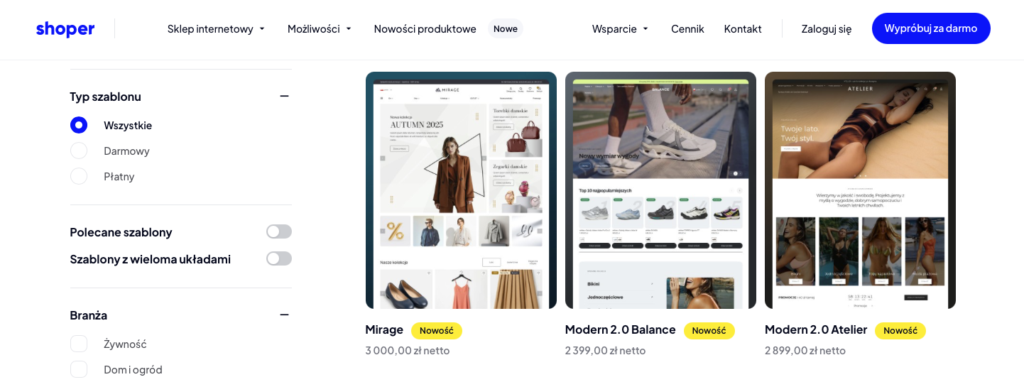
In the template catalog, you'll find both free and paid designs. In the editor, you arrange home page modules, such as bestsellers, new arrivals or product of the day, and the template adapts to mobile screens. If a ready-made template isn't enough, you can order a custom design for your store.
Payments and shipping in a Shoper store
Shoper offers built-in payments called Shoper Płatności, powered by the Polish payment providers Autopay or Przelewy24. Customers can pay by pay-by-link bank transfer, BLIK (Poland's most popular mobile payment method), card, Google Pay or Apple Pay, as well as in installments or with deferred payment. The store also integrates with popular third-party payment systems, such as Stripe.
When choosing a payment system, include transaction fees in your budget, as they're easy to overlook. The amount depends on the payment provider and your store's plan, and rates change over time. You can check the current terms on Shoper's website and on your payment provider's website.
You can handle shipping through the Shoper Przesyłki service or through direct integrations with courier companies and parcel lockers, including InPost, DHL, DPD, UPS and FedEx. You create a shipment directly from the order in the store dashboard, so the whole purchase process, from cart to shipping, stays in one place.
Shoper also offers financial services for merchants, including financing and a business bank account.
Apps, integrations and multichannel selling
You add features that aren't available out of the box from the Shoper App Store, a catalog of hundreds of free and paid extensions. Shoper also lets you connect your store to Google Analytics 4, Polish price comparison sites such as Ceneo and Skąpiec, and review platforms like TrustMate.
Multichannel selling is handled by Apilo, a system from the same group. The free Apilo Lite app provides two-way integration with Allegro, Poland's largest online marketplace, so you manage listings and orders from both channels in your store dashboard. Through Apilo, you can also connect Amazon, eBay, Empik or OLX, as well as wholesalers if you want to sell through dropshipping.
For invoicing and inventory, you can use Shoper's own module, Shoper Faktury i Magazyn, or ready-made integrations with popular Polish ERP systems such as Subiekt GT, enova365 or Comarch software. If your store needs to work with your company's internal system, Shoper provides an open API on every plan. API integration is useful, for example, when you sync stock levels with a wholesaler.
The number of language versions of your store isn't limited by your plan. You can accept payments from customers abroad through Stripe, including in euros or pounds.
SEO and marketing on Shoper
Shoper also has basic SEO and promotion tools that are enough to get started. In the dashboard, you can set meta titles and descriptions, as well as SEO-friendly URLs for products and categories. On every plan, you can also run a blog, which helps your store show up in search results for customer questions.
For sales and customer retention, you get a newsletter module, discount codes, gift cards, a loyalty program and product recommendations (Shoper Rekomendacje). You can run ad campaigns on Google Ads, social media, Allegro and Amazon from the dashboard through the Shoper Kampanie service, which is paid separately.
As a store grows, the built-in tools often stop being enough. A newsletter works well for sending messages to your subscriber list. It's harder to use it to respond to a specific customer's behavior, such as an abandoned cart, a price drop on a product they're watching or the right time for a repeat purchase.
That's what marketing automation platforms for e-commerce are for. They combine order and customer behavior data and use it to send emails, text messages and push notifications. ExpertSender integrates with Shoper and many other popular e-commerce platforms, including Shopify, WooCommerce and PrestaShop.
For Shoper, the ExpertSender integration is based on a webhook that sends data about orders, customers and marketing consents to the platform. Store events then trigger communication workflows.
If you'd like to see how these workflows run on data from a Shoper store, book a demo of the ExpertSender platform.
How much does Shoper cost? Standard and Premium plans
According to the price list in effect since February 2026, Shoper Standard regularly costs 299 PLN per month and Shoper Premium costs 729 PLN per month (prices exclude VAT). Standard is the cheapest plan. In the first year, Shoper usually offers promotional prices, which vary throughout the year.
Regular prices in PLN, excluding VAT, based on Shoper's price list in effect since February 2026. Prices are often much lower in the first year and during seasonal promotions, such as Black Friday. Check current rates on Shoper's pricing page (in Polish).
Promotional prices usually apply when you pay upfront for the first 12 months. From the second year, you pay the regular price. If you renew for a year upfront, Standard costs 3,249 PLN and Premium 7,849 PLN (excluding VAT).
It's worth keeping an eye on Shoper's pricing. The platform runs seasonal promotions, for example around Black Friday, when the first year of a subscription can cost over 90% less than the regular price.
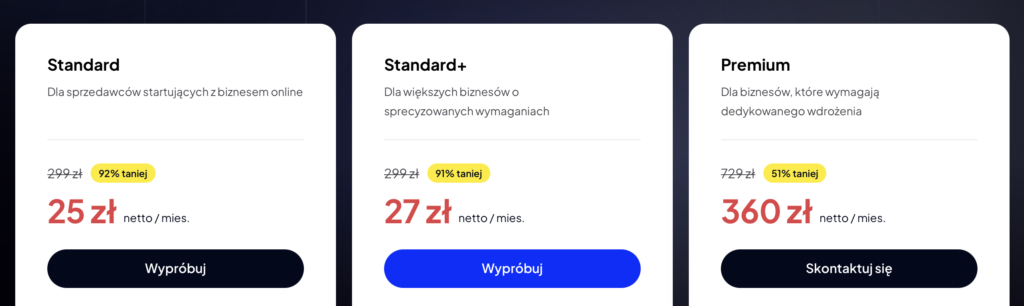
Standard and Standard+ include the same features. Standard+ adds a discount on any paid template from the catalog. On the Premium plan, you get support for up to 50 warehouses, custom modules and cart editing in the template, faster page loading (Premium Cache), 24/7 support and an implementation manager, among other things.
On top of your plan's price, budget for extra costs: a paid template, apps from the App Store, payment fees and a domain.
Shoper pros and limitations
Shoper's main advantages are a fast launch and a close fit with the Polish market. Its limitations come mainly from the closed SaaS model and higher costs after the first year.
Key advantages:
- Launch without a developer or hosting. You set up the store yourself, and the provider takes care of servers and updates.
- Integrations for Polish e-commerce. BLIK, InPost, Allegro, Subiekt GT and price comparison sites work without extra coding.
- Local support. Help is available in Polish by phone, email and chat.
- Regulatory compliance. The software is kept up to date with the GDPR, the Omnibus Directive (it shows the lowest price from the 30 days before a discount) and the GPSR.
- Open API and language versions on every plan. You don't need to upgrade to sell abroad or connect your store to your own system.
Main limitations:
- No access to the source code. Deeper changes to your store's design and cart are only possible on the Premium plan.
- A price jump after the first year, and no plan in between Standard at 299 PLN and Premium at 729 PLN per month (excluding VAT).
- Some features are Premium-only. These include support for multiple warehouses and advanced template editing.
- Add-on costs. Paid templates, apps and payment fees can noticeably raise your monthly bill.
Before you sign an annual subscription, read Shoper reviews in merchant groups and on independent forums. Still, a 14-day trial with your own products will tell you the most.
Who is Shoper a good fit for?
Shoper works well when you want to start selling in Poland quickly and don't want to deal with servers. It's often an ideal solution for new merchants, small and medium-sized online stores and brands that also sell on Allegro. You can focus fully on your product, marketing and customer service, while the store runs without technical work on your side.
For a foreign brand entering Poland, Shoper can be a practical way to launch a dedicated Polish store, with local payments, carriers and marketplaces available from day one. If you mainly sell in other markets, check first whether the integrations you need are available.
Shoper Premium is aimed at larger stores. It's useful when you have a wide product range, several warehouses, high traffic or need to extend your template with custom modules.
Shoper is a weaker choice for highly unusual processes or when your team needs advanced features or full control over the code. In that case, compare it with WooCommerce or Magento. If you plan to sell globally from the start, look at Shopify as well. Before you decide, list your needs and compare them with the features of each plan.
Frequently Asked Questions (FAQ)
Is Shoper an online store?
No, Shoper isn't a store where you shop. It's a Polish platform for building and running online stores, and thousands of e-commerce businesses from various industries use its software. When you buy from a store built on Shoper, your contract is with the merchant, not with Shoper.
How much does Shoper cost per month?
The regular price is 299 PLN per month on the Standard and Standard+ plans and 729 PLN on Premium (excluding VAT). In the first year, Shoper usually offers a promotional price when you pay for 12 months upfront. Payment fees, paid templates and apps come on top of the subscription.
Is Shoper safe?
Yes. The platform has DDoS protection, 24/7 monitoring, automatic updates and a stated uptime of 99.9%. You can secure dashboard logins with two-factor authentication. Strong passwords and staff permissions are up to you.
What kinds of stores use Shoper?
Shoper hosts stores from many different industries, from fashion and home goods to digital products such as e-books and courses. Both one-person brands and larger companies on the Premium plan use it. Shoper shows examples in its customer stories (in Polish).
Shoper vs Shopify - which should you choose?
It depends on your store, not on the platform itself. Both run on the SaaS model, so hosting and updates are included in the subscription, and you can offer BLIK payments or InPost shipping on either one.
They differ in pricing, app catalogs and how they integrate with the services you use, such as Allegro or accounting software. Compare them against the markets you sell in, and test both before you decide.
How does Shoper work?
Shoper runs on the SaaS model: you pay a subscription and run your store in a web browser. The provider handles hosting, updates and security, while you manage products, orders and payments in the admin dashboard.
Can you connect a Shoper store to Allegro?
Yes. The free Apilo Lite app provides two-way integration with Allegro. You then manage listings and orders from the marketplace in your store dashboard, together with orders from your online store.
Latest Resources
We share our knowledge







-
![]()
Dashboard
-
![]()
Customer Profile 360°
-
![]()
Preference Center
-
![]()
Website personalization
-
![]()
Consents Management
-
![]()
Automated emails
-
![]()
Email Raports
-
![]()
High Deliverability
-
![]()
User real-time tracking
-
![]()
Automated scenarios
-
![]()
RFM analysis
-
![]()
Drag & drop editor
-
![]()
Omnichannel marketing
-
![]()
Recommendation frames
-
![]()
Message checklist
-
![]()
Banners, pop-ups, forms