Cross-selling and up-selling in e-commerce: 8 ways to boost revenue

In the world of e-commerce, rising customer acquisition costs mean that retailers are increasingly looking for ways to increase the value of each order, rather than focusing solely on acquiring new customers. This is where proven techniques come into play, allowing you to generate higher revenue without having to increase website traffic.
Is it possible to sell more to the same customer without being pushy? It turns out that it is - provided you have a good understanding of their needs and the moment when they make a purchasing decision. This is precisely why cross-selling and up-selling have been the cornerstone of effective sales strategies for years.
In this article, we’ll show you how to use cross-selling and up-selling techniques in your online shop so that you can realistically increase the average order value and CLV by showing different variants (Customer Lifetime Value).
What are cross-selling and up-selling? - an explanation of the terms
Cross-selling and up-selling are sales techniques that involve offering customers complementary or more expensive products to increase the order value.
In practice, cross-selling involves suggesting other products to the customer that complement their choice. Up-selling, on the other hand, focuses on presenting a better version of the product, often of higher quality and at a slightly higher price.
👉 Examples of cross-selling include:
- a case and screen protector when buying a smartphone,
- a filter, cleaning solution and a supply of coffee when buying an espresso machine,
- a belt or tie when buying a shirt.
In cross-selling, it is crucial to offer the customer products that actually meet their needs.
👉 An example of cross-selling and up-selling in practice:
- the customer selects a laptop, and the system displays a model with more memory (up-selling),
- whilst suggesting the purchase of a mouse and a bag (cross-selling).
Remember that well-executed up-selling isn’t about ‘pushing’ more expensive products, but about genuinely tailoring the offer to the customer’s needs and expectations.
8 cross-selling and up-selling techniques that really work
Cross-selling and up-selling work best when they’re tailored to the stage of the purchasing journey and the customer’s actual needs.
The biggest mistake? Recommending random products without context. Effective cross-selling and up-selling is all about precision - the right product, the right moment, the right message.
Below you’ll find 8 proven techniques that genuinely increase the average order value and improve the e-commerce customer experience.
STAGE 1: Product page
The greatest potential for cross-selling and up-selling lies on the product page - the very place where the customer makes their purchasing decision.
This is the moment when the customer is analysing a particular product and is most open to suggestions. Here, cross-selling involves complementing their choice, whilst up-selling involves showcasing a better option.
1. Show recommended products
The simplest yet highly effective way to boost sales in your e-commerce business? Showing products chosen by other customers.
Examples of this approach include sections such as:
- “Other people also bought”
- “Frequently bought together”
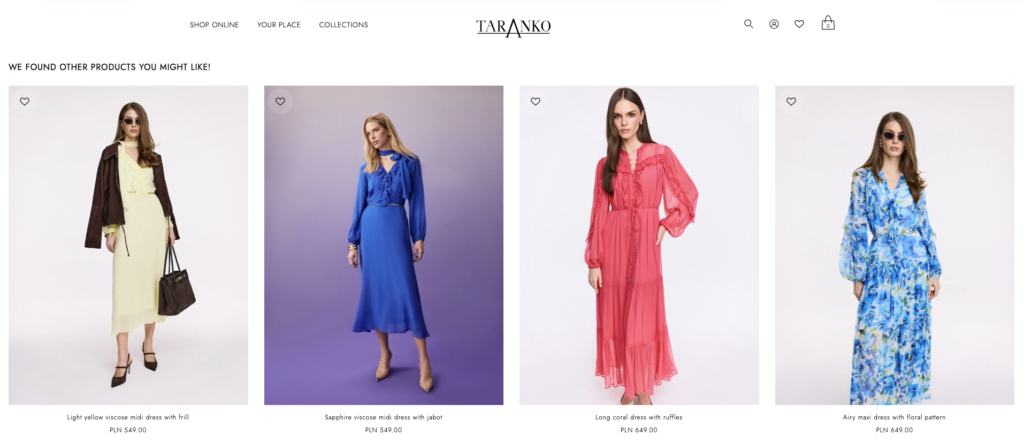
It’s best if this is supported by an advanced recommendation engine based on the customer’s purchase history and activity (including across other channels).
Read also: Omnichannel - what is it and how does it work? >>>
2. Suggest what goes well with a given product
Instead of random suggestions, it is better to propose additional solutions that genuinely enhance the product’s utility. The customer does not want more products - they want a complete solution to their problem.
An example of such cross-selling could be:
- laptop → bag + mouse
- bicycle → helmet + lights
- camera → memory card + tripod
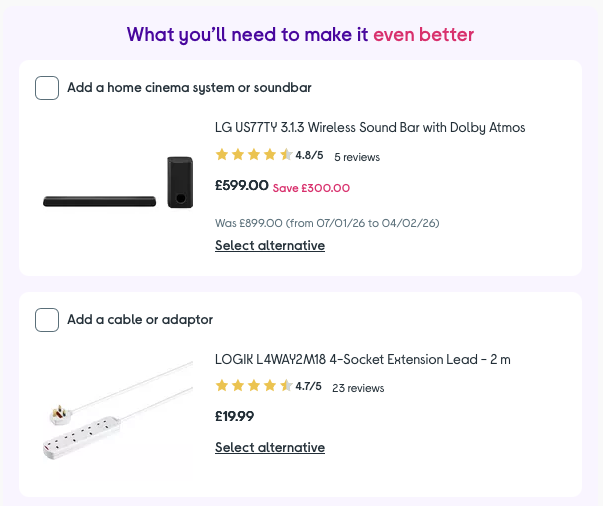
It is precisely this kind of match that makes cross-selling a natural part of the purchasing decision, rather than pushy upselling.
3. Offer a better version for an additional charge
This is one of the simplest ways to increase the order value. The customer is already interested in the product, so we try to offer them a slightly better solution.
The key is balance - a small extra charge, greater value.
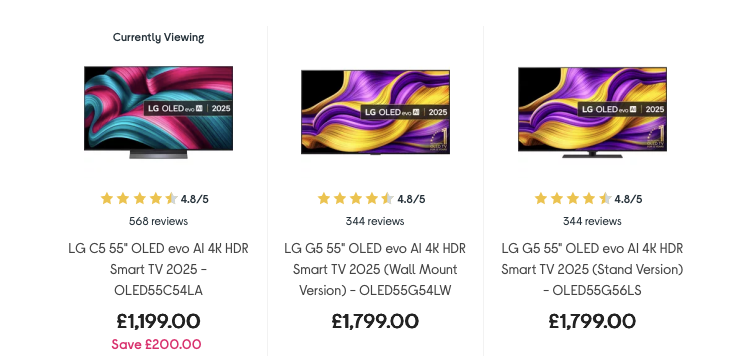
Examples:
- more storage on a smartphone or laptop,
- more power in a vacuum cleaner or pressure washer,
- a higher temperature setting on a hair straightener or oven,
- an extended warranty or additional features.
Well-designed up-selling is based on demonstrating real benefits. If the customer sees the value, the decision to pay extra becomes natural, and showing different options simply pays off for us.
4. Sell products in bundles
Instead of suggesting a single additional product, you present a complete set (a ‘bundle’) - coherent, convenient and often cheaper than buying items separately.

Examples:
- hair care set: shampoo + conditioner + hair mask
- gaming set: keyboard + mouse + mouse mat
- coffee set: cups + coffee supply + flavoured syrup
A well-designed bundle is not just about generating additional sales, but also about increasing perceived value. The customer gets more for a relatively lower price, whilst you increase the value of the cart and the effectiveness of your sales efforts.
STAGE 2: Cart and checkout (last chance to increase the cart value)
The Shopping Cart and Checkout are the moment when the customer is just one step away from finalising their purchase - this is where cross-selling and up-selling work most effectively.
The customer has already made their purchasing decision, so any well-chosen suggestion can increase the order value without the risk of losing the conversion. This is the last moment to influence their choice.
5. Encourage free delivery above a certain amount
One of the most effective ways to increase the cart value is a clearly displayed free delivery threshold. It’s simple psychology - the customer would rather add another product than pay for delivery.
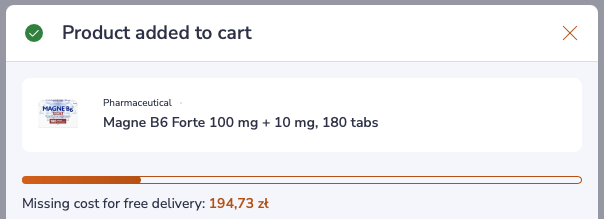
Examples:
- You are ‘x’ dollars short of free delivery
- Add products worth ‘x’ dollars and get free delivery
The whole art of this tactic lies in subtly suggesting that it’s worth adding another product to achieve a specific benefit. It works even better to highlight specific products that make up the remaining amount - ones that match what the customer already has in their cart.
6. Use time limits or limited availability
Time limits or limited availability increase the customer’s tendency to make a quick purchasing decision. This is a classic technique that works in both cross-selling and up-selling - the customer sees that the offer is available only for a short time or in limited quantities, so they are less likely to put off the decision.
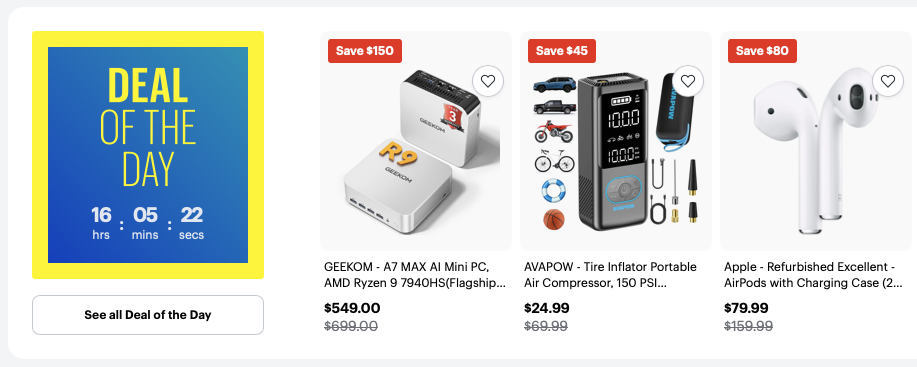
Examples:
- offer valid for a limited time only,
- offer valid until 31 March,
- only 3 items of this product left,
- promotion on a set - today only,
- discount on another product when purchased by Thursday.
Skillfully utilised cross-selling and up-selling, combined with a time limit, can significantly speed up the completion of a purchase and increase the order value.
STAGE 3: Post-purchase upselling
Cross-selling and up-selling do not end with the completion of the purchase. This is just the beginning. After placing their first order, customers are more open to further suggestions. They are already familiar with your shop, have come to trust the brand, and have a lower barrier to purchase than new users.
This is the perfect moment for additional sales and building customer loyalty, without the pressure or risk of cart abandonment.
7. Cross-sell after purchase (email and thank-you page)
The most effective post-purchase cross-selling involves sending related offers and recommendations tailored to the order.
You can use:
- a post-purchase thank-you page,
- an order confirmation email,
- a follow-up email after a few days.
What to suggest:
- complementary products to the purchased item,
- additional solutions that enhance its usability,
- upgraded versions or extensions (up-selling).
This is the moment when cross-selling involves tailoring the offer to the customer’s actual purchase - not to assumptions. Well-designed post-purchase solutions can increase customer lifetime value (CLV).
But remember: consciously limit the number of products you suggest. Emotions often prompt us to make the most of this moment and show everything we can sell. However, we know from experience that the ‘less is more’ approach is the better guide in this case.
STAGE 4: Marketing Automation and tailoring offers to the customer
The most effective cross-selling and up-selling is data-driven - that is, tailoring the offer to a specific customer. Manual efforts have their limitations. In e-commerce, true scale is only achieved through automation, i.e. the use of data on customer behaviour, purchase history and preferences.
This is where the real advantage begins. You don’t show everyone the same thing; instead, you tailor the offer to the customer’s needs.
8. Personalisation and segmentation within automated workflows
Personalisation in Marketing Automation allows you to automatically tailor cross-selling and up-selling activities to customer behaviour.
Instead of guessing, you use data:
- what the customer has viewed,
- what they have bought previously,
- at what stage of the purchasing process they are.
Based on this, you can trigger:
- recommendations tailored to the relevant customer segment,
- automation scenarios (e.g. after placing the first order, after abandoning the cart, etc.),
- dynamic cross-selling and up-selling across various channels.
This approach allows you to make effective use of cross-selling and up-selling. No manual work and no risk of misguided suggestions.
👉 If you want to implement such solutions in practice - let’s talk!
A well-designed automation system not only increases order value but also improves the customer experience and helps build long-term loyalty.
Summary
Cross-selling and up-selling are among the most effective ways to maximise profits and increase order value without acquiring new customers.
Well-implemented sales techniques - from the product page, through the shopping cart, right up to Marketing Automation - allow you to increase the average cart value and build loyalty. The key is to tailor your approach to the moment and the customer’s needs, rather than randomly suggesting products.
If you want to generate higher revenue in e-commerce, focus on the consistent use of cross-selling and up-selling throughout the entire purchasing process.
Frequently Asked Questions (FAQ)
What does up-selling mean?
Up-selling is the sale of a more expensive or better version of a product. It involves encouraging the customer to choose a variant of higher quality, with greater capabilities or additional features, often for a small extra charge.
What does cross-selling mean?
Cross-selling is the sale of complementary products. It involves suggesting other products to the customer that match their choice and enhance the usefulness of the main product.
What are some examples of cross-selling in the e-commerce industry?
An example of cross-selling is suggesting products that complement the selected product. This could be, for example, a laptop bag and mouse, a bicycle helmet or accessories for electronic equipment.
How can you increase the cart value in e-commerce?
The most effective way is to use cross-selling and up-selling at various stages of the purchasing process. Additionally, it is worth offering a free delivery threshold, personalised offers, and well-matched product recommendations.
Latest Resources
We share our knowledge







-
![]()
Dashboard
-
![]()
Customer Profile 360°
-
![]()
Preference Center
-
![]()
Website personalization
-
![]()
Consents Management
-
![]()
Automated emails
-
![]()
Email Raports
-
![]()
High Deliverability
-
![]()
User real-time tracking
-
![]()
Automated scenarios
-
![]()
RFM analysis
-
![]()
Drag & drop editor
-
![]()
Omnichannel marketing
-
![]()
Recommendation frames
-
![]()
Message checklist
-
![]()
Banners, pop-ups, forms